


If you have ever landed on a web page that keeps repeating the same phrase, you might have wondered why anyone would write that way. The wording often feels awkward, slightly forced, and out of step with how people naturally speak or read. It is rarely a stylistic choice. More often, it is the result of keyword stuffing.
Years ago, this tactic actually worked. Search engines were simpler, and repeating a keyword enough times could push a page up the rankings. While some people still cling to the idea that more keywords automatically mean better search engine optimisation (SEO), that assumption is now a costly mistake.
Modern search engines are far better at interpreting context, intent, and natural language. Readers are also less tolerant of content that sounds repetitive or manufactured. When keywords are forced into every sentence, readability suffers, even if the underlying information is accurate. Understanding why this tactic no longer works requires a closer look at what keyword stuffing actually involves and how optimisation has evolved.

What Keyword Stuffing Looks Like in Practice
Keyword stuffing is a black-hat SEO tactic in early ranking systems that placed heavy emphasis on keyword frequency. In those environments, repeating a term could signal relevance regardless of content quality. Although search engines have long moved beyond this model, the practice still appears in modern content in several recognisable forms.
In Pages Titles and Meta Description

Keyword stuffing in metadata occurs when titles or descriptions are written to repeat a target phrase rather than describe the page clearly. Because space is limited, repetition becomes noticeable very quickly.
This often results in titles and meta descriptions that feel long, awkward, or cluttered. Instead of helping users understand what the page offers, the wording prioritises keywords over meaning. Search engines now evaluate metadata in context, and keyword-driven phrasing can weaken both usefulness and search performance.
In the Main Content
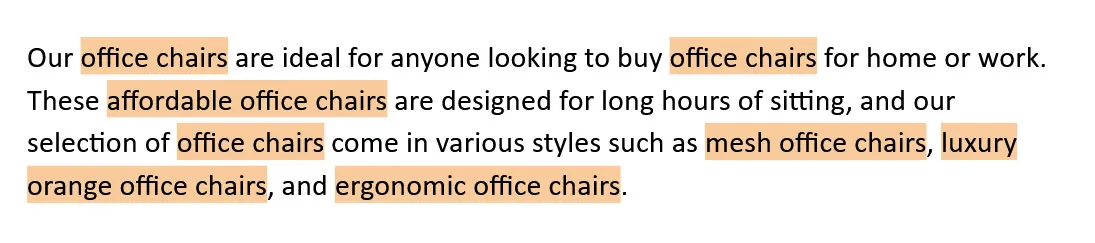
Excessive repetition within body text is the most common and often the least obvious form of keyword stuffing. A phrase may be repeated frequently within a short section, even when it adds no new information.
Each sentence may read clearly on its own, but together the repetition disrupts flow and focus. This usually happens when optimisation takes priority over natural language. Modern search systems can detect this pattern and may treat it as over-optimisation, even when the content itself appears useful.
Hidden Text and Links
Hidden text and links are a more deliberate form of keyword stuffing, where keywords are placed on a page in ways users cannot easily see. Common methods include:
- Matching text to the background colour
- Using extremely small font sizes
- Positioning content off-screen
- Placing text behind images
The intent is to expose keywords to search engines without affecting visible content. Google explicitly classifies this as a violation of its spam policies. Even when hidden elements seem minor, they signal an attempt to manipulate rankings and can result in severe penalties, including significant ranking losses or removal from search results altogether.
Why Keyword Stuffing Hurts SEO Today
Keyword stuffing hurts SEO because it runs counter to how search engines assess quality and relevance. Search systems interpret intent, context, and natural language rather than reward repeated phrases. When content relies on keyword repetition instead of clear, structured explanation, it signals an attempt to influence rankings rather than meet user needs.
Violates Google’s Quality and Spam Guidelines
Google’s spam policies for Search classify keyword stuffing as a manipulative practice when it is used to influence rankings instead of providing value. Excessive repetition, irrelevant keyword lists, and hidden text are treated as spam signals. These tactics do not improve relevance and can weaken a page’s performance, even without a visible penalty.
Conflicts With How Search Systems Interpret Content
Modern search systems analyse content through structure, context, and semantic relationships. AI-driven models assess how clearly ideas are expressed, how well concepts connect, and whether a page demonstrates topical focus. Repetitive wording can dilute meaning and reduce precision, making it harder for systems to understand what the content genuinely covers. This often results in suppressed rankings that are difficult to diagnose or reverse.
Reduces Eligibility for AI-Powered Search Features
Keyword stuffing can also affect how content is surfaced beyond traditional rankings. AI-powered features such as AI overviews and large language model summaries prioritise readability, coherence and depth. Content built around repetition rather than explanation is less likely to be selected, summarised, or cited, reducing visibility even when rankings appear stable.
Harms User Experience and Brand Trust
Beyond search performance, keyword stuffing shapes how content is perceived. Repetitive or awkward phrasing makes pages harder to read and can undermine confidence in the brand behind the content. Over time, this weakens trust, particularly in competitive markets where accuracy, credibility, and professionalism matter.

What Should You Do Instead of Keyword Stuffing?
Avoiding keyword stuffing does not mean ignoring SEO. It means shifting focus from repetition to relevance, usefulness, and intent. Effective optimisation helps search engines understand your content by presenting ideas clearly and naturally. When content is well structured and genuinely helpful, keywords appear in the right places without being forced. The following approaches offer a more sustainable alternative to keyword stuffing.
Focus on a Handful of Keywords Per Page
Each page should centre on a small group of closely related keywords tied to a single, well-defined topic. Attempting to target too many phrases often leads to repetition and diluted messaging. A narrower focus allows you to explain the subject in depth, cover supporting ideas, and use natural language variations. This improves clarity for readers and makes it easier for search engines to understand the page’s purpose. Focused pages are easier to optimise, easier to read, and more likely to perform consistently over time.
Check Your Content’s Readability
Readability is a strong signal of content quality. Awkward phrasing, repeated wording, or overly complex sentences often indicate that optimisation has overtaken communication. Reviewing content for flow, structure, and coherence helps reveal where keywords may have been overused. Reading text aloud or using readability tools can highlight problem areas quickly. Clear, natural language benefits both users and search systems, improving comprehension, trust, and overall performance.
Put Yourself in Your Audience’s Shoes
One of the most effective ways to avoid keyword stuffing is to write with your audience in mind. Focus on the questions they are trying to answer and the information they actually need. Content built around user intent naturally reduces unnecessary repetition and encourages clearer explanations. When writing is guided by usefulness rather than keywords, relevance follows more organically. This approach also strengthens trust, as readers are more likely to engage with content that feels informative and human, not engineered for algorithms.
At Activa Media, We Target Your Keywords the Right Way
Keyword stuffing persists because it feels like a shortcut, but it offers no advantage in search today. Modern optimisation rewards clarity, intent, and usefulness, not repetition. Search engines, AI systems, and users favour content that is focused and genuinely helpful. Forced keywords weaken rankings, reduce visibility, and erode trust. Sustainable SEO comes from audience-first content where relevance develops naturally.
Activa Media eliminates the risks of outdated SEO practices such as keyword stuffing by replacing them with strategies designed for how search works today. Our SEO specialists and content strategists collaborate to create content that search engines trust and audiences value. By prioritising structure, intent, and depth over repetition, we help brands secure lasting visibility and sustainable growth across Singapore and the region. Get in touch with our specialists today to review your SEO approach and discover how sustainable optimisation can strengthen your digital presence.


